 apply now
 (213) 385 – 7781
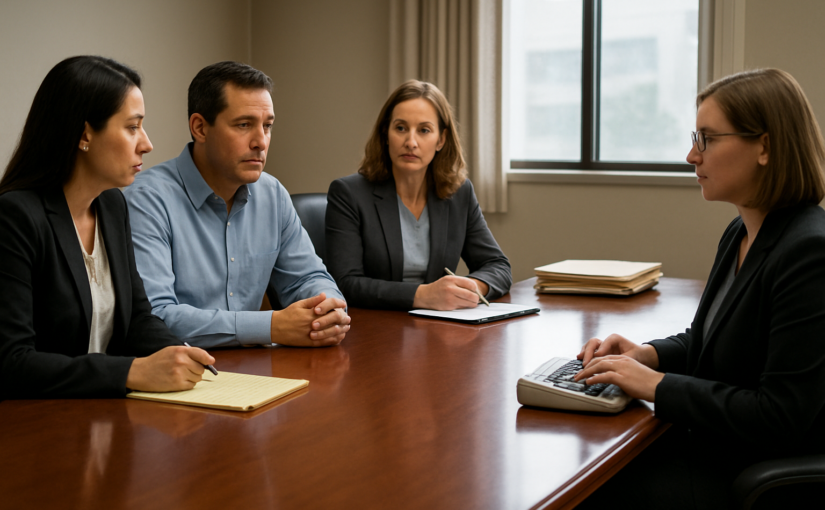
For interpreters entering the legal field, understanding depositions and terminologies is essential. Depositions may look less formal than courtroom proceedings, but they are still sworn legal events where every word matters. For aspiring court interpreters, learning how to manage the physical setup, the pace of questioning, overlapping speech, and common objections can make the difference between a smooth assignment and a stressful one.
This guide explains the basics of depositions and terminologies for interpreters, with practical strategies for handling real-world challenges. If you are training for legal work or preparing for certification, mastering depositions is a key step in building the accuracy, professionalism, and stamina expected in the field.
What Is a Deposition?
A deposition is a formal out-of-court proceeding in which a witness, party, or expert gives sworn testimony before trial. Depositions are usually conducted in a law office, conference room, or another informal setting rather than in a courtroom. Even so, the testimony is taken under oath, recorded by a court reporter, and may later be used in motions, settlement negotiations, impeachment, or trial.
For interpreters, depositions require many of the same core skills used in court:
- Precise listening
- Faithful rendering of questions and answers
- Control of register and tone
- Ability to manage turn-taking
- Understanding of legal terminology
- Professional conduct on the record
The major difference is the environment. Depositions can feel conversational, but they often move quickly and become chaotic when multiple attorneys speak at once, interrupt, or make objections during testimony.
Why Depositions Matter for Legal Interpreters
Many new interpreters assume courtroom work is the center of legal interpreting. In reality, interpreting depositions is a significant and specialized part of legal practice. Civil litigation, personal injury cases, employment disputes, family law matters, and criminal-related proceedings may all involve depositions.
Depositions matter because they test an interpreter’s ability to:
- Maintain accuracy under pressure. Attorneys may ask long, layered questions packed with dates, names, and legal concepts.
- Work in less structured spaces. Informal conference rooms rarely offer ideal acoustics or seating arrangements.
- Handle objections correctly. The interpreter must render objections such as “Form,” “Hearsay,” or “Speculation” without explanation, editing, or summarizing.
- Protect the record. Since a deposition transcript may later be scrutinized in court, the interpreter must preserve exact meaning and alert speakers when interpretation is compromised.
For students preparing for court certification, depositions are also excellent training for speed, concentration, and legal vocabulary.
Who Is Usually in the Room?
Although every case is different, a typical deposition may include:
- The witness or deponent
- One or more attorneys
- A court reporter
- An interpreter
- A videographer, in some cases
- A party representative, paralegal, or legal assistant
Unlike a courtroom, there may be no judge present. That means attorneys often control the pace and tone of the proceeding. The interpreter must remain neutral and professional while ensuring that the interpreted communication is complete and intelligible.
How a Deposition Usually Begins
Swearing In on the Deposition Record
One of the first procedural moments interpreters should expect is being placed on the record. The court reporter may identify everyone present and ask the interpreter to state their name and role. In many depositions, the interpreter is also sworn to provide a true and accurate interpretation.
The exact wording varies by jurisdiction and by the court reporter or attorney, but it often sounds something like this:
“Do you solemnly swear or affirm that you will accurately and impartially interpret from English into Spanish and from Spanish into English to the best of your skill and judgment?”
The witness is then sworn in as well.
As an interpreter, be prepared to:
- State your full name clearly for the record
- Confirm the language pair
- Take the interpreter’s oath if requested
- Interpret the witness oath accurately and completely
If anything is unclear, ask for repetition before the record proceeds. It is better to clarify at the start than to create confusion in the transcript.
Ground Rules Often Given to the Witness
Attorneys frequently explain deposition ground rules before substantive questioning begins. These may include instructions such as:
- Answer verbally, not with gestures
- Wait until the question is finished
- Do not guess if you do not know
- Ask for clarification if you do not understand
- Take breaks when needed, unless a question is pending
These instructions are especially important in interpreted depositions. The interpreter should render them carefully because they support a cleaner record and reduce later disputes.
Navigating Informal Conference Rooms
One of the biggest surprises for students learning depositions and terminologies for interpreters is that the physical environment can be harder than the language itself. A courtroom is structured. A conference room is not.
Common Room Challenges
- Poor acoustics
- People seated too far apart
- Side conversations
- Papers shuffling near microphones
- Attorneys speaking while looking down at documents
- Rapid exchanges without clear turn-taking
Because depositions are transcribed, these environmental issues matter. If the interpreter cannot hear clearly, the interpretation and the transcript may both suffer.
Practical Setup Tips
Before the deposition starts, try to position yourself where you can hear both the examining attorney and the witness. Ideally, you should be close enough to the witness to interpret comfortably without forcing them to turn away from the questioner.
- Sit where you can maintain direct auditory access to both languages.
- Avoid being placed behind the witness if that will distort sound.
- Ask politely for one speaker at a time if multiple attorneys are discussing logistics.
- Request a brief adjustment if the room setup prevents accurate interpretation.
A simple professional statement can help: “For the accuracy of the interpretation, I need to be able to hear each speaker clearly. May we adjust seating slightly?”
This is not overstepping. It is part of protecting the record.
Interpreting Mode in Depositions
Most witness testimony in a deposition is interpreted consecutively. The attorney asks a question, the interpreter renders it into the witness’s language, the witness answers, and the interpreter renders the answer into English.
However, there may be moments requiring other modes:
- Consecutive: the primary mode for question-and-answer testimony
- Sight translation: when a witness is shown a short document, signature page, or written statement
- Simultaneous or whispered interpreting: occasionally used for brief attorney comments to a client, depending on the context and ethical boundaries
Interpreters should know the expectations in advance whenever possible. If asked to sight translate a document, take a moment to review it first if allowed. If the document is lengthy or highly technical, state clearly that a full written translation is different from an oral sight translation and may require additional time or qualifications.
Managing Cross-Talk and Interruptions
Cross-talk is one of the most common and difficult realities of interpreting depositions. Attorneys may interrupt witnesses. Opposing counsel may object before a question is completed. A witness may begin answering before the interpretation is finished. People may forget that the interpreter needs one speaker at a time.
Why Cross-Talk Is a Serious Problem
When two people speak at once, the interpreter cannot fully capture both messages. The court reporter may also struggle to create an accurate transcript. In interpreted proceedings, overlap can distort meaning, erase nuance, and increase the risk of later disputes about what was said.
Best Practices for Managing Overlap
- Intervene promptly and neutrally. If speech overlaps, say: “Interpreter requests one speaker at a time for the record.”
- Do not guess. If part of a statement was inaudible, ask for repetition.
- Preserve sequence. If the attorney and witness overlap, identify which portion needs to be repeated first.
- Use first person when interpreting testimony. This helps keep the exchange direct and reduces confusion.
- Maintain composure. Your tone should stay calm even if the room becomes tense.
Interpreters are not controlling the proceeding; they are protecting accuracy. That distinction is important.
Attorney Objections: What Interpreters Need to Know
A core part of learning depositions and terminologies is becoming comfortable with objections. In depositions, objections are usually stated briefly for the record. Unlike at trial, many objections do not stop the witness from answering. Instead, they preserve an issue for later review.
The interpreter’s job is not to analyze, simplify, or explain the objection. The job is to interpret it faithfully.
Three Common Objections
1. “Form”
This is one of the most frequent deposition objections. “Form” usually signals that the question is defective in some way, perhaps vague, compound, leading, argumentative, or confusing. In many jurisdictions, counsel says only “Objection, form” or simply “Form.”
For interpreters, the key point is this: render exactly what was said. Do not expand it into a legal lesson for the witness.
Example:
- Attorney: “Objection. Form.”
- Interpreter: faithful equivalent in the target language of “Objection. Form.”
2. “Hearsay”
“Hearsay” generally refers to an out-of-court statement offered to prove the truth of the matter asserted. In depositions, attorneys may object on hearsay grounds even though the witness may still answer.
Again, the interpreter should not paraphrase this as “they object because someone else said it.” That would be an explanation, not an interpretation.
3. “Speculation”
This objection indicates that the question calls for a guess rather than personal knowledge. It is common when an attorney asks what another person “must have known,” “intended,” or “would have done.”
Interpret the objection precisely and neutrally, then continue with the sequence of the proceeding.
Other Objections You May Hear
- Asked and answered
- Foundation
- Misstates testimony
- Calls for a legal conclusion
- Privilege
- Compound
- Vague and ambiguous
The phrase defending objections deposition sometimes appears in legal discussions about how defending counsel states objections during questioning. Interpreters should understand the context but remain in their lane: render the objection accurately, preserve tone, and avoid becoming part of the legal strategy.
Key Deposition Terminology Interpreters Should Know
Building a strong glossary is one of the smartest ways to prepare for depositions. Below is a practical list of terms commonly heard in civil depositions. Exact equivalents may vary by language, legal system, and region, so interpreters should verify usage in their working language pair and jurisdiction.
| English Term | Meaning in Context |
|---|---|
| Deponent | The person giving sworn testimony in the deposition |
| Exhibit | A document or item marked for identification during testimony |
| On the record | Statements being officially reported |
| Off the record | A pause in official reporting, if agreed and stated |
| Stipulation | An agreement between the parties or attorneys |
| Counsel | An attorney or lawyer |
| Court reporter | The professional creating the deposition transcript |
| Read back | A request for the reporter to repeat a portion of the record |
| Clarify the record | To correct or specify what was said |
| Pending question | A question that has been asked but not yet answered |
When studying depositions and terminologies for interpreters, do not memorize isolated words only. Practice hearing them in realistic question-and-answer exchanges, objections, and procedural instructions.
Realistic Scenario: A Fast-Paced Personal Injury Deposition
Imagine you are interpreting for a Spanish-speaking plaintiff in a personal injury case. The deposition takes place in a conference room with two attorneys, a court reporter, and a videographer. The plaintiff appears nervous. The examining attorney asks long questions about medical treatment, prior injuries, and lost wages.
Early in the deposition, several challenges appear at once:
- The attorney reads from records while speaking quickly and softly.
- Opposing counsel interrupts with “Objection, form” before the question is fully interpreted.
- The witness begins answering immediately, before hearing the full interpretation.
- Someone slides papers across the table, creating noise during the answer.
A skilled interpreter handles this by pausing the flow respectfully:
- First, the interpreter asks for the full question to be completed before the witness answers.
- Second, the interpreter renders the objection exactly as stated.
- Third, the interpreter requests repetition of the portion masked by overlap.
- Fourth, the interpreter continues in a steady first-person delivery.
For example, the interpreter might say: “Interpreter requests that the question, objection, and answer be taken one at a time for accuracy.”
This intervention is brief, neutral, and record-focused. It does not favor either side. It simply preserves intelligibility.
Accuracy, Ethics, and Professional Boundaries
Depositions can tempt inexperienced interpreters to “help” the witness understand legal language or to soften hostile exchanges. That is not the interpreter’s role.
What to Do
- Interpret everything said that is intended for the witness or for the record
- Maintain the speaker’s tone and register as closely as possible
- Ask for repetition or clarification when needed
- Disclose any issue that affects accuracy, such as fatigue, inaudibility, or dialect difficulty
What Not to Do
- Do not explain legal strategy
- Do not summarize long questions unless instructed and clearly permitted, which is rare in formal testimony
- Do not coach the witness
- Do not omit profanity, hedging, or uncertainty
- Do not engage in side conversations about the case
Professional standards vary by jurisdiction and assignment type, so interpreters should confirm applicable rules with the hiring entity, court, or agency. For legal and medical certification pathways, official sources may include the Judicial Council of California, the National Center for State Courts, NBCMI, CCHI, IMIA, and NCIHC. Requirements, fees, eligibility rules, and testing procedures can change, so always verify current details directly with the official source.
Preparation Tips for Students and New Interpreters
If you want to become confident in interpreting depositions, preparation should go beyond vocabulary lists.
Build a Deposition Practice Routine
- Study common objections. Learn how they sound at natural speed.
- Practice long consecutive segments. Depositions often involve multi-part questions.
- Shadow legal audio. Work on pace, register, and attorney rhythm.
- Create bilingual glossaries. Include procedure, anatomy, employment, insurance, and accident-related terms.
- Role-play conference room dynamics. Practice managing overlap and asking for repetitions professionally.
Focus on Register and Precision
Depositions often shift between plain language and technical language. One moment the attorney asks, “Where were you standing?” and the next asks, “Did you execute this release knowingly and voluntarily?” The interpreter must move smoothly between registers without flattening meaning.
Train for Endurance
Depositions can last several hours. Concentration, note-taking, hydration, and posture matter. In some settings, team interpreting may be appropriate for lengthy or complex assignments, but practices vary. Confirm expectations with the agency or hiring party in advance.
FAQ: Depositions and Terminologies for Interpreters
Do interpreters need to be sworn in during a deposition?
Often, yes. Many depositions place the interpreter under oath to provide a true and accurate interpretation. Procedures vary, so listen carefully and be ready to identify yourself on the record.
Should an interpreter explain objections like “Form” to the witness?
No. The interpreter should render the objection faithfully, not explain it. If the attorney wants to clarify the objection or instruction, that explanation must come from counsel, not the interpreter.
What should an interpreter do when people talk over each other?
Intervene briefly and neutrally. Ask for one speaker at a time so the interpretation and transcript remain accurate.
Are depositions always consecutive interpreting assignments?
Mostly, but not always. Consecutive is standard for testimony, while sight translation may be needed for exhibits and simultaneous may occasionally arise in limited contexts.
Where can aspiring interpreters confirm certification details?
Check official sources such as your state court system, the Judicial Council of California where applicable, the National Center for State Courts, NBCMI, CCHI, IMIA, and NCIHC. Fees, policies, and exam requirements change over time.
Conclusion
Mastering depositions and terminologies is a major milestone for anyone pursuing legal interpreting. Depositions demand more than bilingual ability: they require procedural awareness, control in informal conference rooms, skill in managing cross-talk, and precision when rendering objections such as “Form,” “Hearsay,” and “Speculation.” They also require confidence with being sworn in on the record and maintaining strict neutrality from beginning to end.
For aspiring court and medical interpreters, deposition work is excellent preparation for certification-level performance. The more you train with realistic legal scenarios, authentic terminology, and professional protocols, the more prepared you will be for real assignments and formal exams.
If you are ready to strengthen your legal interpreting skills and prepare for certification, visit interpretingschool.com. Train with purpose, build confidence in depositions and terminologies for interpreters, and take the next step toward a professional interpreting career.